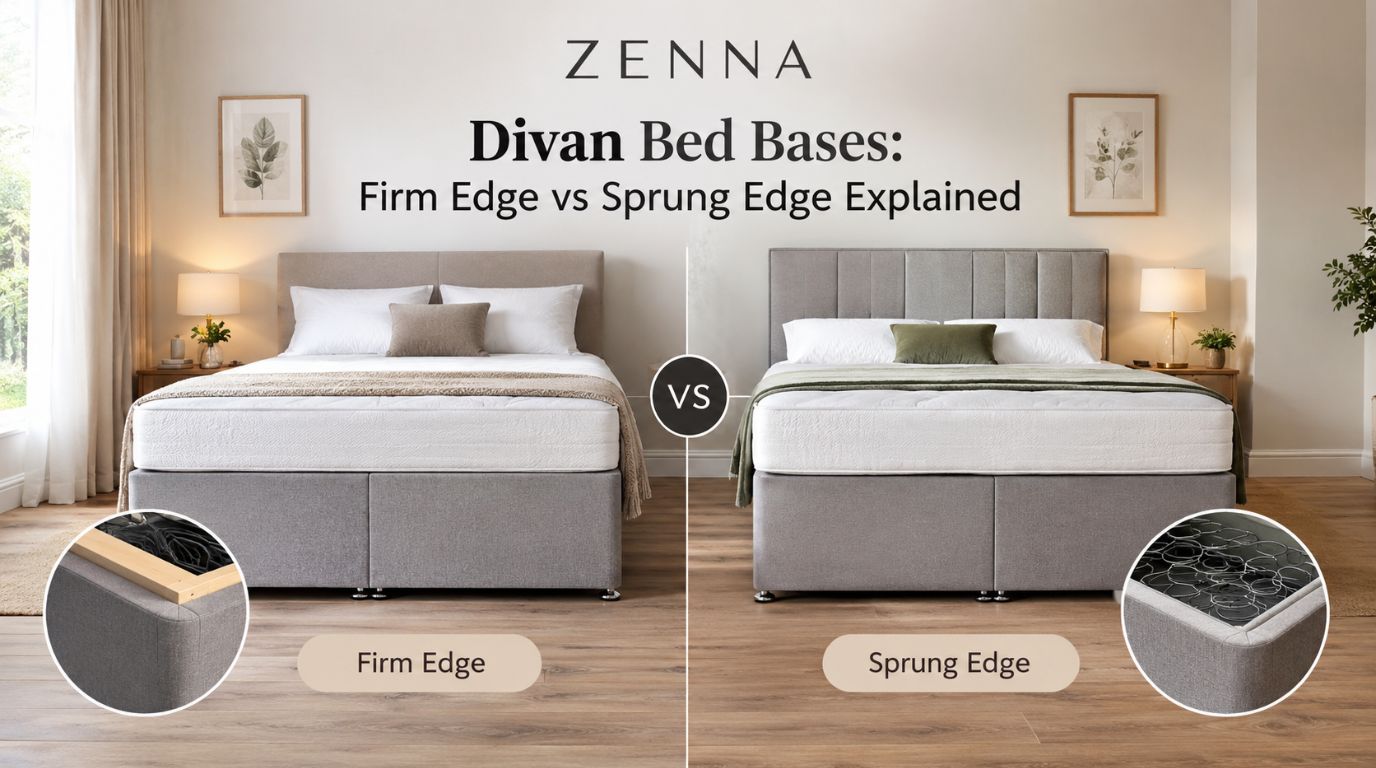
Choosing the right divan bed base directly affects your mattress’s comfort, feel, and lifespan. Knowing the difference between firm edge and sprung edge helps you

A slatted bed base consists of a framework of horizontal wooden boards designed to hold your mattress and provide good ventilation. At Zenna, we believe this product will improve your sleep quality, while its slatted bed base benefits will increase your mattress’s lifespan. Whether it is a soft or a firm mattress that you desire, basic knowledge such as this is essential.
A slatted bed base is the frame of the bed made up of a row of wooden boards placed across the width. Slats provide an open frame that allows the mattress to have proper ventilation, apart from providing a flat enclosed surface through the solid base.
When considering the benefits of slatted beds, one cannot help but notice that the most important benefit is that of having ventilation combined with structural integrity.

It is necessary to know about sprung slats vs flat slats to customize your sleep environment.
| Feature | Sprung Slats | Flat Slats |
| Flexibility | Yes, slight give/bounce | Rigid, no flex |
| Best for | Memory foam, latex, hybrid | Firm, orthopaedic |
| Lumbar Support | Enhanced absorbs movement | Stable, firm platform |
| Airflow | Excellent | Excellent |
| Lifespan | May need adjustment over time | Very durable |
| Material | Pine/beech with rubber caps | Pine or birch strips |
When considering slat spacing for mattresses, precision is key. The industry standard is a gap of no more than 7–8 cm.
However, both wood types are organic and environmentally friendly, and their choice will determine how much pressure your mattress will endure and the performance of the slats, ensuring proper bed base support.
A strong bed base works like a lid on a box, keeping heat and moisture right under you. Enhancing mattress breathability is a common issue in the weather of the United Kingdom, as there is plenty of moisture that can easily accumulate.
These days, almost every mattress manufactured will fit perfectly onto the slatted bed frame. It is important to look at sprung slats vs flat slats and read and comply with the rules of mattress manufacturers before buying the bed frame to avoid future problems with the warranty policy.
Making a smart purchase by investing in a quality Zenna slatted bed frame can be one of the best choices you could make in terms of improving your sleep experience. Due to their high-quality ventilation, along with tailored support, such as a base, will guarantee complete protection of your mattress, as well as added comfort for you.
Choose Zenna Beds for expert-crafted slatted bases that optimize mattress longevity, superior airflow, and personalized spinal support.
Weight and imbalanced pressures cause it; avoid it by not jumping on them.
The industry standard gap is under 7 cm to prevent sagging and maintain your mattress warranty.
Sprung slats offer flexible, shock-absorbing support, while solid slats provide a firm, rigid, and highly durable foundation.
Yes, but use closer spacing (3–5 cm) to prevent the foam from dipping between the slats.
Yes, the gaps promote essential airflow, which prevents heat build-up and reduces moisture trapped under the mattress.
Choosing the right divan bed base directly affects your mattress’s comfort, feel, and lifespan. Knowing the difference between firm edge and sprung edge helps you
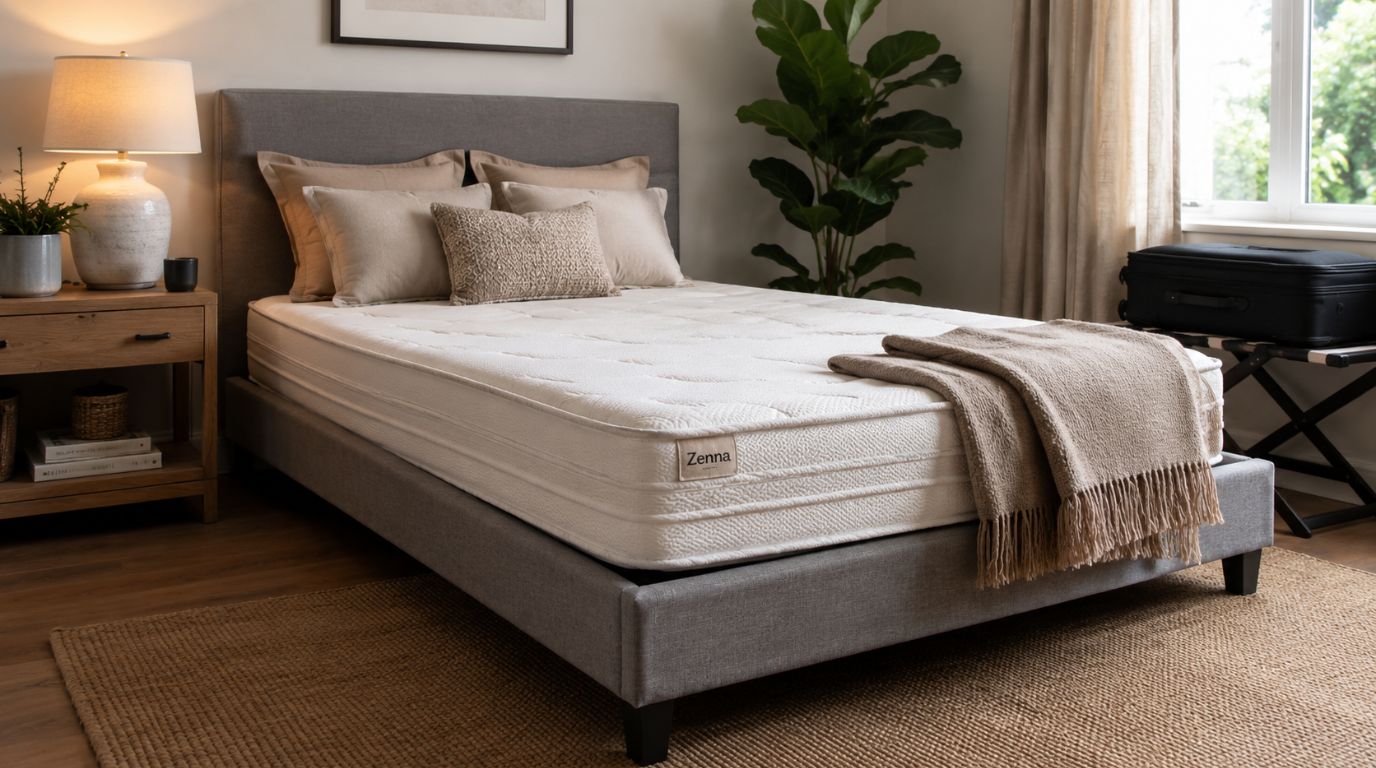
A guest room is not usually used all the time, but the bed still needs to offer a good night’s sleep. Selecting the right setup
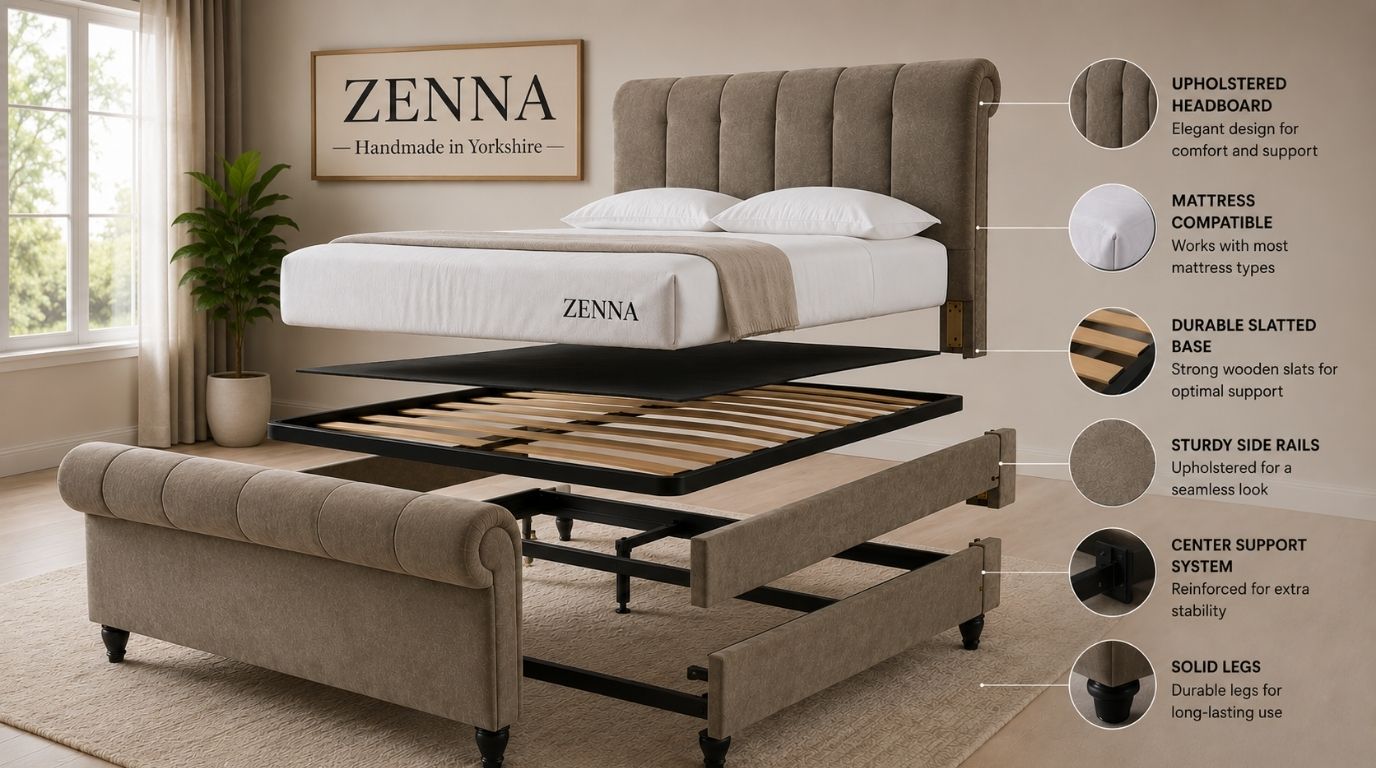
A sleigh bed is easy to recognise by its curved headboard and footboard. A traditional sleigh bed inspires its shape and has been used in